Western carpenter ants (Camponotus modoc) do not consume cellulose like subterranean termites; instead, they hollow out damp wood framing to excavate smooth galleries for brood rearing. In historic Douglas fir frames…
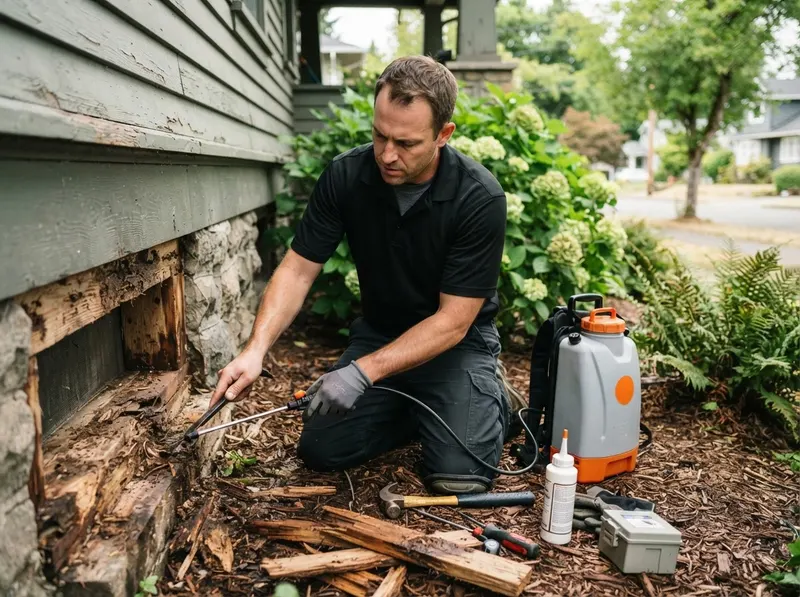
Western carpenter ants (Camponotus modoc) do not consume cellulose like subterranean termites; instead, they hollow out damp wood framing to excavate smooth galleries for brood rearing. In historic Douglas fir frames common throughout the Proctor District, Old Town, and Stadium District, moisture intrusion from Puget Sound rain patterns creates prime softening along rim joists, crawlspace sill plates, and window headers. When worker ants enter wall voids, they leave fine wood shavings mixed with insect fragments known as frass. According to structural pest guidance from the Washington State University Extension, localized colony management requires locating interior satellite nests while tracing foraging trails back to primary parent nests situated in decaying stump wood, landscape ties, or exterior tree cavities.
Effective structural remediation differs from generic topical spraying. Broadcast aerosol applications often fail because chemical repellents scatter satellite colonies deeper into dry wall studs, expanding the zone of framing damage. Clearstone Pest Guard applies systematic non-repellent transfer chemistry and micro-injected desiccant dusts directly into verified structural voids. Formulations align with the chemical safety and environmental benchmarks outlined by the United States Environmental Protection Agency. Treatments focus on targeted barrier zones rather than blanket surface saturations, ensuring materials dry cleanly around crawlspaces, subflooring, and structural sill plates without risking interior living quarters.
Structural interventions follow three distinct steps to resolve infestations without recurring auto-billing lock-ins. First, a certified technician maps crawlspace timbers, attics, and exterior margins using moisture meters and void scopes compliant with the inspection standards of the Washington State Department of Agriculture. Second, direct non-repellent micro-treatments are injected into colonized framing voids and exterior entry thresholds. Third, physical moisture discrepancies are documented according to building envelope recommendations from the Building Science Corporation so property owners can eliminate damp conditions that attract wood-boring insects. For outdoor perimeter management, vegetation clearances align with urban timber guidelines from the Washington State Department of Natural Resources to sever travel bridges touching exterior siding.
Pierce County properties face persistent pest pressure along wooded greenbelts, including areas near Point Defiance Park, the West End, and Lincoln District. To maintain regional compliance, structural treatments adhere to environmental discharge criteria established by the Washington State Department of Ecology, preventing wash-off into municipal stormwater systems governed by the City of Tacoma. Health and home safety parameters follow guidance from the Washington State Department of Health and regional housing habitability directives cataloged by the Tacoma-Pierce County Health Department. Clearstone Pest Guard provides targeted physical barrier installations and focal void treatments designed to halt structural excavation without pressuring owners into mandatory monthly subscription programs.
Every job gets a firm, written price after a free on-site visit.
For standards, safe disposal, and service guidance on PEST CONTROL SERVICE in Tacoma, WA, useful references include U.S. EPA, ENERGY STAR, U.S. Dept. of Energy, Consumer.gov, U.S. Census Bureau, and Google Maps. General consumer and small-business resources are available from USA.gov, Better Business Bureau, FTC Consumer Advice, U.S. Small Business Administration, and Ready.gov.
Tell us about your carpenter ant structural remediation job in Tacoma and we'll send a clear, written quote, usually the same day.
 Clearstone Pest Guard