Subterranean termite soil treatment operates by binding a non-repellent liquid chemical agent directly to soil particles encircling a home's foundation. Because subterranean termites travel upward from subterranean…
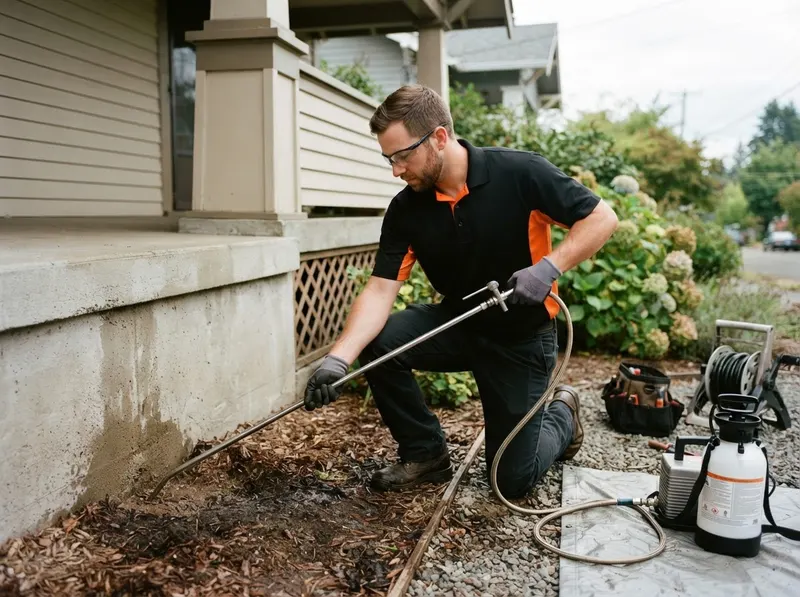
Subterranean termite soil treatment operates by binding a non-repellent liquid chemical agent directly to soil particles encircling a home's foundation. Because subterranean termites travel upward from subterranean nests to feed on structural cellulose, interrupting this migration route protects structural wall plates and joists. Pierce County soils, heavily influenced by glacial drift, sand, and high winter water tables near the Puget Sound, require trenching depths of 6 inches by 6 inches alongside exterior foundation stems. Technicians rod liquid material down to the footing level at calculated intervals dictated by the Environmental Protection Agency chemical application guidelines. Liquid termiticides work through structural transfer: worker termites pass through treated soil unnoticed, ingest the active agent, and transfer the material through social grooming to reproductive castes within the sub-surface nest.
Pierce County soil structures differ significantly by neighborhood, which influences how barriers settle. Properties constructed with unreinforced rubble foundations or stacked river rock in Old Town and the Stadium District demand systematic low-pressure pressure-injection along stem walls. Conversely, post-and-pier crawlspaces situated in South Tacoma, Fern Hill, and the Lincoln District encounter damp subterranean environments that promote dampwood and subterranean pest activity. Guidance outlined by the Washington State Department of Agriculture pesticide laws dictates proper soil saturation volume, establishing a standard application rate of 4 gallons of termiticide mixture per 10 linear feet per foot of depth down to footings. Technicians utilize calibrated flowmeters to verify these ratios, preserving environmental boundaries near residential vegetable plantings and rain gardens.
Subterranean soil treatments present clear mechanical trade-offs when contrasted with perimeter monitoring bait stations. Liquid soil treatment establishes an immediate, continuous lethal boundary that functions for 5 to 10 years without requiring monthly station rebaiting contracts. However, concrete flatwork such as walkways, patios, and slab porches in Proctor District and West End properties necessitates mechanical drilling. Technicians bore 0.5-inch holes through masonry slabs every 12 inches to saturate soil underneath, subsequently sealing openings with hydraulic cement matching surrounding aggregate. For guidance on foundation structural clearance and structural ventilation, properties refer to specifications in the Whole Building Design Guide foundation details. Liquid treatments do not replace structural repairs; cellulose debris, wood scraps buried in crawlspaces, and untreated timber ground contact must be physically separated to halt insect attraction, as detailed in the HUD housing structural maintenance handbooks.
Execution of treatment involves four consecutive mechanical steps:
1. Excavating a continuous 6-inch by 6-inch trench directly against exterior foundation masonry walls, separating foundation soil from siding clearances.
2. Sub-surface rodding into trench bottoms at 12-inch horizontal spacing to deposit termiticide directly beside footings, in accordance with OSHA residential excavation standards.
3. Precision core-drilling exterior concrete slabs, carports, and adjoining sidewalk pads to rod foundational soil trapped beneath impermeable surfaces.
4. Blending the excavated soil back into the trench with targeted liquid saturant, sealing the chemical barrier, followed by structural inspection per the National Pest Management Association standards. Homeowners can reach our certified applicators directly at (253) 648-3783 for verifiable barrier assessments.
Every job gets a firm, written price after a free on-site visit.
For standards, safe disposal, and service guidance on PEST CONTROL SERVICE in Tacoma, WA, useful references include U.S. EPA, ENERGY STAR, U.S. Dept. of Energy, Consumer.gov, U.S. Census Bureau, and Google Maps. General consumer and small-business resources are available from USA.gov, Better Business Bureau, FTC Consumer Advice, U.S. Small Business Administration, and Ready.gov.
Tell us about your subterranean termite soil treatment job in Tacoma and we'll send a clear, written quote, usually the same day.
 Clearstone Pest Guard